Quick Summary. Website in 2027
- Your Website Is a Business Asset You Control: Social platforms, marketplaces, and search can attract visitors, but their rules and reach may change. A useful website gives your business a stable place to build trust, answer questions, and help people take the next step.
- SEO Still Matters as Search Evolves: Search engines still rely on clear topics, helpful links, strong performance, and trustworthy information. As people ask fuller questions and encounter AI summaries and other search features, content should answer their intent rather than just repeat keywords.
- Make Your Website a Clear, Credible Source: AI-powered search is more likely to understand useful content that is specific, current, easy to access, and supported by evidence. Explain who is responsible for the information, show relevant experience, and keep business details consistent.
- Create Content That Solves Real Problems: Guides, comparisons, checklists, demonstrations, and other practical resources help people make decisions without relying on a hard sales pitch. First-hand examples and regular updates make this content more distinctive and trustworthy.
- Structure and Technical Quality Build Understanding: Descriptive headings, concise summaries, clear internal links, accessible design, and relevant structured data help visitors and automated systems navigate a site. Reliable hosting, HTTPS, mobile-friendly performance, crawlable pages, and accurate maintenance provide the foundation.
1. Your Website in 2027 Is Still Your Digital Home
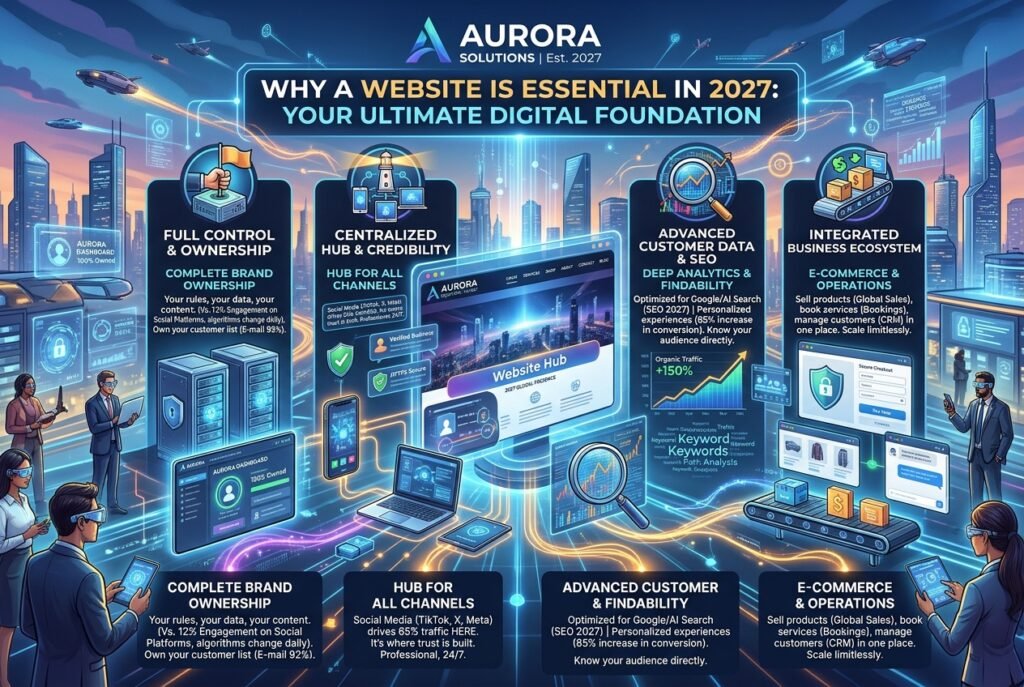
Your business may be found on TikTok, Instagram, a marketplace, a search engine, or through an AI assistant. These channels can bring attention fast. But they are not a replacement for a website you own. Their rules, fees, algorithms, and reach can change at any time.
A website gives your business a stable online home. You can use it to explain your services, answer common questions, collect leads, sell products, share helpful resources, and build trust. You control the design, brand, message, customer experience, and much of the data from these interactions.
This control matters for your Website in 2027. A person may first find your business through a social post, video, search result, or AI search result. Before they buy or book a service, they may still visit your website. They may want to check your prices, read reviews, compare options, learn about your experience, or find your contact details.
Your website should do more than show that your business exists. It should help visitors take the next step. You could offer a useful calculator, show how your products work, answer detailed questions, share customer results, or provide a simple way to request a quote.
A traditional website is still worth building, but it should not be an outdated online brochure. It must help real people and be clear enough for systems that read, summarize, and recommend online content. The businesses that gain the most will use their websites as trusted and useful resources, not just as online signs.
2. Search Has Changed, but For Your Website in 2027 SEO Still Matters
SEO has not disappeared. Search engines still need to discover, crawl, understand, index, and rank web pages. Useful keywords, clear page topics, logical internal links, fast performance, and trustworthy information remain important foundations.
What has changed is the way people search. Instead of typing a few disconnected words, they increasingly ask complete questions, describe a problem, or explain what they are trying to accomplish. Someone might search for “best accounting software for a small business” or ask, “How can I reduce my monthly energy bill?” They expect a useful answer, not a page that simply repeats matching phrases.
Search results have also become more varied. Alongside traditional links, users may see AI-generated summaries, answer panels, product information, local listings, videos, forums, images, and other features. In some cases, they receive enough information to make a decision before clicking a standard blue link.
Being included in AI Search Results is not as simple as adding an AI-related phrase to a page. These systems look for relevance, accuracy, context, evidence, and a useful match for the searcher’s intent. SEO therefore needs to move beyond trying to rank one page for one keyword. A stronger approach covers a subject thoroughly, answers related questions, and helps visitors complete a task.
Keyword research still matters, but it should reveal how customers describe their concerns, compare options, and express their goals. Use those insights to shape genuinely helpful content. Do not force exact phrases into every paragraph. Natural, focused writing is better for readers and more useful to the systems trying to understand it.
3. How Websites Can Become Useful Sources for AI
AI-powered search systems need dependable information they can interpret, summarize, compare, and cite. A website is more likely to be considered when its content is clear, specific, current, and supported by evidence. This matters whether someone is searching through a traditional engine or looking for answers in AI Search Results.
Write for the question behind the search, not just the visible keyword. If you sell a service, explain what it is, how it works, what it costs, when it may not be suitable, what alternatives exist, and what customers should expect. Include examples and common follow-up questions where they genuinely help.
Put important facts in plain language, close to the subject they explain. Do not hide essential details inside images, pop-ups, complicated interfaces, or downloadable files that some visitors and systems may struggle to access. Descriptive page titles, headings, summaries, captions, image alternative text, and meaningful link text create useful signals for both people and automated systems.
Trust also depends on knowing who stands behind the information. Show the author or reviewer, particularly for content about health, finance, law, safety, or other high-impact decisions. Include relevant qualifications, practical experience, sources, and a way to contact the business.
Keep your business details consistent across your website and reputable external profiles. Accurate names, addresses, service areas, opening hours, and product information help systems connect your content to the right organization.
No tactic can force inclusion in AI Search Results. The aim is to become a source that search systems can confidently understand, evaluate, and use.
4. Problem-Solving Content Beats Promotional Content
A page that only says “buy now” has limited value, especially when visitors are still deciding what they need. Problem-solving content is more useful because it meets people at the moment they have a question, concern, or practical obstacle.
Start with real customer situations. Someone may be choosing between two products, trying to fix a common issue, preparing for a purchase, estimating costs, avoiding an expensive mistake, or deciding whether professional help is necessary. These situations can become practical guides, checklists, comparisons, calculators, templates, demonstrations, case studies, FAQs, or troubleshooting articles.
The connection to your business should feel natural. A helpful guide can explain the problem, outline possible solutions, show when your product or service is suitable, and offer a clear next step. It does not need to become an aggressive sales pitch. When the content genuinely helps, readers are more likely to trust the business behind it.
First-hand experience makes these resources stronger. Original examples, test results, photographs, customer stories, expert opinions, and lessons learned offer details that generic summaries often lack. They also give search systems more specific, useful information to understand and associate with relevant questions.
Think beyond the moment before a purchase. Answer questions customers ask during setup, delivery, use, maintenance, and support. Over time, this creates a useful content library and gives AI systems more relevant passages to connect with different searches.
Review older content regularly. Update prices, regulations, examples, and recommendations, remove outdated claims, and explain meaningful changes. Accurate, current information is more persuasive to people and more valuable to search systems than a large volume of neglected pages.
5. Content Structure Helps People and Machines Understand
Strong information can still be overlooked when it is hidden inside a confusing page. Good structure gives readers a clear path and helps automated systems understand how ideas, facts, and pages relate to one another.
Give every page one clear primary purpose and a specific title that describes it accurately. “How to Choose a Business Insurance Policy” tells visitors far more than “Our Solutions” or “Welcome.” For longer articles, use one main heading followed by descriptive subheadings that reflect the questions, topics, or steps covered. Headings should guide the reader, not simply repeat keywords.
Open with a concise answer or summary, then add context, evidence, instructions, examples, and relevant details. This helps visitors who want a quick answer while still supporting those who need deeper information. Short paragraphs, bullet lists, numbered steps, definitions, comparison tables, and highlighted facts can make complex subjects easier to scan.
Internal links should also follow a clear structure. A broad guide might link to detailed advice, product or service pages, customer evidence, and a contact page. Use descriptive anchor text, such as “compare delivery options,” rather than vague labels like “click here.”
Structured data can provide additional context through formats such as Organization, LocalBusiness, Product, Article, FAQ, Event, or Review markup. It supports understanding, but it does not guarantee enhanced listings or inclusion in AI Search Results.
Finally, make pages accessible with strong colour contrast, keyboard-friendly navigation, meaningful link labels, captions where needed, and alternative text for informative images. Clear, accessible content is easier for everyone to understand.
6. Trust, Accuracy, and Technical Foundations Matter
A clear, accessible website also needs solid technical foundations. Important pages should be open to search engine crawlers, rather than accidentally blocked by settings, scripts, or a faulty robots.txt file. Use sensible, readable URLs that show what each page is about, and make sure the site loads reliably when visitors arrive.
HTTPS, responsive design, mobile-friendly layouts, and stable performance are basic expectations. A slow or frustrating website can lose customers even when its information is excellent. Clear navigation also helps people and search systems understand how pages relate to one another.
Technical maintenance matters as a site grows. Create an XML sitemap when appropriate, keep canonical signals accurate, repair broken links, and redirect retired pages carefully. Avoid creating large numbers of duplicate or thin pages, since they can make it harder for search systems to identify the most useful information.
Trust also depends on showing that a real, accountable organization stands behind the website. Include an About page, contact details, customer service information, relevant policies, and authorship details. Support factual claims with reliable sources, distinguish original findings from outside information, and show meaningful publication or update dates when freshness matters.
Reviews and testimonials should be genuine. Explain how they were collected, avoid fabricated endorsements, and never present unverified claims as facts. Protect visitor information with sensible privacy and security practices, making forms, payments, subscriptions, and data use easy to understand.
Technical SEO removes barriers and improves interpretation, but it cannot replace useful content. A well-structured website still needs accurate answers, helpful resources, and evidence that gives people a reason to stay.
7. Build a Website in 2027 Around the Complete Customer Journey
A useful website should support the entire customer journey, not just the final purchase. Someone discovering a business for the first time may need simple definitions, educational guides, or advice on choosing between options. A ready-to-buy visitor may be looking for pricing, availability, comparisons, guarantees, delivery details, or a consultation form. Create content for each stage so visitors can find the information they need without having to ask the same questions repeatedly.
Important products, services, locations, audiences, and use cases may deserve their own pages, but only when each page provides genuinely different information. Publishing near-identical pages with slightly changed keywords can make a site harder to use and less trustworthy. Focus on useful detail instead.
Different formats can also make information easier to understand. Demonstration videos, diagrams, photographs, transcripts, downloadable tools, and interactive features give people more than one way to learn. Each important page should also offer a natural next step, such as reading a related guide, checking availability, requesting a quote, booking a call, or buying a product.
Other channels should support the website, not replace it. Social posts, newsletters, videos, podcasts, communities, and marketplace listings can bring people to deeper resources on your site.
Measure more than traffic. Track qualified inquiries, sales, bookings, downloads, returning visitors, assisted conversions, and questions raised with support teams. Monitor how your brand appears in search and AI Search Results, but remember that AI answers change and may not produce a click. Combine analytics with customer feedback and conversion data.
Over time, your website should become a living knowledge base, improved by real conversations, search questions, sales objections, support requests, and changes in the market.
8. The Website of 2027 Will Be the Best Answer, Not Just the Loudest Result
Your website should be the place customers turn to when they need a clear answer, a trustworthy recommendation, or the confidence to take the next step. It brings ownership, credibility, useful content, customer service, and conversion opportunities together in one durable asset. Social platforms will shift and AI tools will evolve, but a well-maintained website gives your business a stable foundation you control.
The winning approach is not to flood the internet with endless pages or chase every new AI feature. It is to understand what customers are trying to accomplish, then make the best answer easy to find, understand, and use. Traditional SEO still supports that goal through discoverable pages, relevant topics, strong technical performance, useful internal links, and clear signals about your business and expertise.
To improve your chances of appearing in AI Search Results, give search systems richer material to work with. Add deeper context, direct answers, structured information, original experience, reliable evidence, and clear authorship. Make important details understandable in short passages as well as within the complete page. There is no guaranteed formula, but genuinely useful content gives search systems better information to interpret, trust, and recommend.
A practical starting plan is straightforward: audit your current website, identify the questions customers ask most often, improve the pages that answer them, add proof and clearer structure, remove technical barriers, and review the results regularly.
The Website in 2027 should not be a digital brochure gathering dust. It should be a trusted, organized, continually updated resource that helps people make confident decisions. The clear takeaway is this: businesses that consistently provide the best answers will be better positioned to earn attention from customers, search engines, and AI-powered discovery systems.